 Grade
GradeHow To Recover From A Bad Test Grade and Boost Your Average
Education Expert
Last Updated: August 2026
Table of Contents
- Introduction
- The Immediate Aftermath: Processing the Grade
- Step 1: Breathe and Keep Perspective
- Step 2: The Deep Analysis of Your Exam
- Step 3: Communicating With Your Professor
- Step 4: Adjusting Your Study Habits
- The Power of Active Learning
- Time Management Strategies for Students
- Mindset Shift: From Fixed to Growth
- Preparing for the Next Exam
- Advanced Recovery Strategies for Difficult Subjects
- Building Long-Term Psychological Resilience
- Frequently Asked Questions
- Conclusion
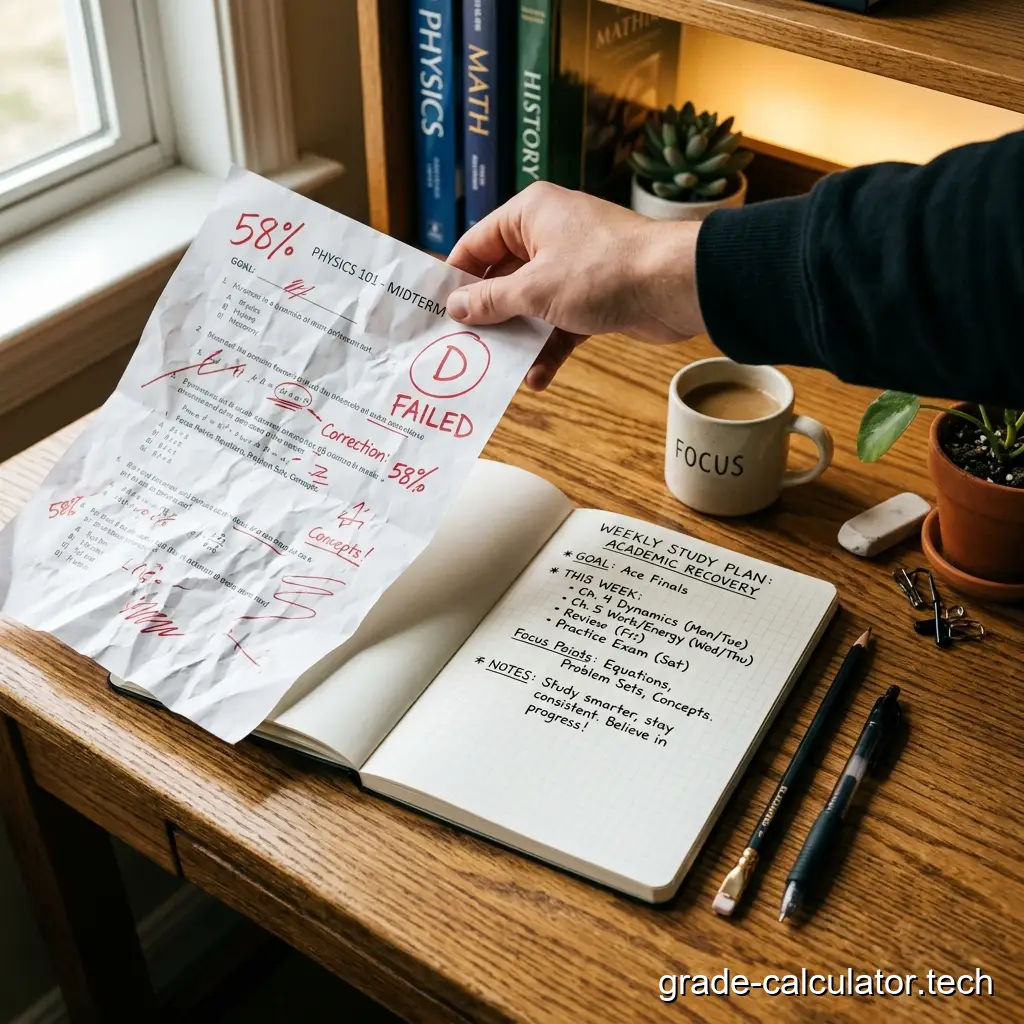
Introduction to Grade Recovery
Figuring out exactly how to recover from a bad test grade can feel like an impossible challenge when you are staring at a surprisingly low score. We have all been there. You spent hours reviewing the material, skipping social events to prepare, only to receive a grade that leaves you questioning your abilities and your future in the course. The feeling of disappointment, frustration, and even panic is entirely normal. However, a single bad grade does not define your intelligence or seal your academic fate. It is merely a data point, an indicator that your current approach needs recalibration.
The journey from a disappointing result to a successful outcome requires a systematic approach. It is not about simply 'trying harder' next time; it's about trying differently. In this comprehensive guide, we will explore the precise steps you need to take to bounce back from a poor exam performance. From managing your initial emotional reaction to implementing evidence-based study techniques, we will cover every aspect of the recovery process.
Academic resilience is a skill that can be developed. The most successful students are not those who never fail, but rather those who know how to extract valuable lessons from their failures. By viewing this setback as a learning opportunity, you can develop habits and strategies that will serve you well not only in this class but throughout your entire educational journey.
Let's dive into the detailed, step-by-step process of academic recovery and transformation.
The Immediate Aftermath: Processing the Grade
When you first see that low number circled in red or displayed on your student portal, your brain often goes into a state of shock. The amygdala, the brain's emotional center, can hijack your logical thinking processes, leading to catastrophic thoughts like 'I am going to fail this class' or 'I am not smart enough for this major.' It is crucial to recognize these thoughts as an emotional reaction, not an objective reality.
During this initial phase, the most important thing you can do is allow yourself to feel the disappointment without letting it consume you. Suppressing the frustration can lead to apathy, while wallowing in it can lead to despair. Acknowledge that you are upset because you care about your education, which is fundamentally a positive trait.
Give yourself a designated 'mourning period'—perhaps an hour or an afternoon—to be upset about the grade. Vent to a trusted friend or write in a journal. But once that period is over, you must consciously shift your focus from the past (the bad grade) to the future (what you are going to do about it).
Step 1: Breathe and Keep Perspective
Before you make any drastic decisions—like dropping the class or changing your major—take a step back and look at the bigger picture. In the grand scheme of your academic career, this one exam is likely just a small fraction of your overall grade. Check your course syllabus to determine exactly how much weight this test carries. You might find that it only accounts for 10% or 15% of your final grade, meaning an A or B is still very much attainable.
Even if the test represents a significant portion of your grade, remember that many professors offer opportunities for redemption. This could take the form of extra credit, a dropped lowest test score, or a cumulative final exam that replaces a previous midterm grade. Do not panic before you have all the facts.
Furthermore, remind yourself that this is a temporary setback. Every successful professional has faced failure at some point. The defining characteristic of success is resilience. Take a deep breath, recalibrate your perspective, and prepare to tackle the problem methodically.
Step 2: The Deep Analysis of Your Exam
Once you have regained your composure, it is time for the most critical step in the recovery process: the post-mortem analysis of your exam. Do not just throw the test in a drawer or delete the PDF. You need to look at it closely, objectively, and analytically.
Go through every single question you missed and categorize the reason for the error. Was it a careless mistake, like misreading the question or making a simple calculation error? If so, your knowledge base might be solid, but your test-taking strategy needs work. You might need to slow down, underline key words in the prompt, and double-check your work.
Or was it a gap in knowledge? Did you simply not know the material? If this is the case, you need to identify *why* you didn't know it. Was it covered in a lecture you missed? Was it in a reading assignment you skimmed? Did you think you understood it but realized during the test that your understanding was superficial? Categorizing your mistakes allows you to target your future study efforts precisely where they are needed most.
Categorizing Your Mistakes
To make this analysis effective, consider creating a simple spreadsheet or chart. Create columns for the question number, the topic it covered, the type of error you made, and what you should have done differently. This might seem tedious, but it transforms a nebulous 'bad grade' into a concrete, actionable list of areas for improvement.
Types of errors often fall into these categories:
- Comprehension Errors: You didn't understand the underlying concept.
- Recall Errors: You understood the concept but couldn't remember the specific details during the test.
- Application Errors: You knew the facts but couldn't apply them to a novel problem or scenario.
- Test-Taking Errors: You misread the question, managed your time poorly, or second-guessed the correct answer.
Step 3: Communicating With Your Professor
One of the most underutilized resources in college is the professor's office hours. Many students are intimidated by their instructors, especially after performing poorly on an exam. However, most professors genuinely want their students to succeed and are more than willing to help those who show initiative and a desire to improve.
Send a polite, professional email to your professor requesting a meeting to discuss your exam. Be clear that your goal is not to argue for more points, but rather to understand your mistakes and learn how to study more effectively for the next test. When you attend the meeting, bring your analyzed exam and specific questions.
For example, instead of saying, 'I don't know why I did so badly,' try saying, 'I noticed I struggled specifically with the application questions on chapter 4. Could you recommend a strategy for practicing this type of problem?' This shows the professor that you have already put in the work to analyze your performance and are seeking targeted guidance.
Asking the Right Questions
During your office hours visit, you can also ask about the structure of future exams, recommended resources (like tutoring centers or study groups), and any potential opportunities to improve your grade. Establishing a positive relationship with your professor can pay dividends down the line, especially if your final grade is borderline.
Step 4: Adjusting Your Study Habits
Einstein famously defined insanity as doing the same thing over and over again and expecting different results. If your current study habits resulted in a bad grade, it is time to change them. Simply spending *more* time studying using ineffective methods will only lead to more frustration. You need to focus on the *quality* of your study sessions, not just the quantity.
Many students rely on passive study techniques, such as re-reading the textbook, highlighting notes, or listening to recorded lectures. While these activities can feel productive, cognitive psychology research has consistently shown that they are highly inefficient for long-term retention and deep comprehension.
Instead, you must transition to active learning strategies. This involves engaging with the material in a way that forces your brain to work hard to retrieve and process information. It might feel more difficult in the moment, but the results on test day will be significantly better.
The Power of Active Learning
Active learning encompasses a variety of techniques designed to strengthen the neural pathways associated with the information you are trying to learn. One of the most effective methods is 'active recall'—testing yourself on the material before you feel completely ready. Create flashcards, use practice quizzes, or simply close your book and try to write down everything you know about a specific topic from memory.
Another powerful technique is 'spaced repetition.' Instead of cramming all your studying into one marathon session the night before the exam, space your study sessions out over several days or weeks. This forces your brain to repeatedly recall the information just as it is beginning to forget it, which dramatically improves long-term retention.
Consider using the Feynman Technique: try explaining the concept you are studying in simple terms, as if you were teaching it to a middle schooler. If you struggle to explain it simply, you have identified a gap in your own understanding that needs to be addressed.
The Benefits of Study Groups
Working with peers can also facilitate active learning. Form a study group with classmates who are serious about improving their grades. Take turns teaching concepts to each other, quiz each other on key terms, and work through complex problems collaboratively. Explaining material to someone else is one of the best ways to solidify your own understanding.
Time Management Strategies for Students
Often, a bad grade is not a result of a lack of intelligence or poor study techniques, but rather poor time management. If you are starting your studying the night before a major exam, even the best active learning strategies will not be enough to save you. You must learn to manage your time proactively and efficiently.
Start by creating a realistic, detailed schedule. Block out time for classes, work, and essential daily activities. Then, schedule specific, dedicated study blocks for each of your courses. Treat these study blocks like non-negotiable appointments. During these blocks, eliminate all distractions: put your phone in another room, use website blockers to avoid social media, and find a quiet, focused environment.
Consider using the Pomodoro Technique: study intensely for 25 minutes, then take a 5-minute break. After four 'Pomodoros,' take a longer break of 15-30 minutes. This structured approach helps maintain high levels of focus and prevents burnout during long study sessions.
Mindset Shift: From Fixed to Growth
Recovering from a bad grade requires a fundamental shift in mindset. Psychologist Carol Dweck's research on 'fixed' versus 'growth' mindsets is highly relevant here. A student with a fixed mindset believes that intelligence and ability are static traits. When they receive a bad grade, they interpret it as a judgment on their inherent intelligence: 'I am just bad at math.'
Conversely, a student with a growth mindset believes that abilities can be developed through dedication and hard work. They view a bad grade not as a reflection of their intelligence, but as feedback on their current level of effort and strategy. They say, 'I didn't study the right way for this math test, but I can learn how to do better next time.'
Cultivating a growth mindset is essential for academic resilience. Embrace challenges, view effort as the path to mastery, and learn from criticism. When you reframe failure as an opportunity for growth, a bad grade transforms from a devastating blow into a powerful catalyst for improvement.
Preparing for the Next Exam
As the next exam approaches, you should have a completely revamped preparation strategy in place. Start your studying well in advance, utilizing the active learning techniques and time management strategies you have developed. Regularly assess your understanding by taking practice tests under simulated exam conditions. This means no notes, a strict time limit, and a quiet environment.
Simulating the exam environment helps reduce test anxiety and ensures that you are truly relying on your memory and understanding, rather than external crutches. When you review your practice tests, apply the same rigorous analysis you used on your bad exam. Identify weaknesses and adjust your study plan accordingly.
On the day before the test, focus on light review and self-care. Do not try to learn new material. Ensure you get a full night's sleep, eat a healthy meal, and arrive at the testing location early, feeling confident in the new and improved strategies you have employed.
Advanced Recovery Strategies for Difficult Subjects
While the fundamental strategies of active recall, spaced repetition, and professor communication apply universally, certain disciplines require specialized approaches when recovering from a poor performance. Understanding how to adapt your study methods to the specific demands of a subject can be the difference between a mediocre recovery and a spectacular comeback.
In STEM (Science, Technology, Engineering, and Mathematics) courses, a bad grade often stems from a failure to grasp foundational concepts, which then cascades into an inability to solve complex, multi-step problems. If you have struggled on a calculus or physics exam, reading the textbook again is rarely the solution. These subjects require relentless practice. You must shift your focus entirely to problem-solving. When you get a practice problem wrong, do not simply look at the solution and nod in agreement. You must deconstruct the solution, understand the mathematical or physical principles applied at each step, and then attempt a similar, novel problem without any assistance. In STEM, understanding the 'why' behind a formula is far more important than merely memorizing the formula itself. Consider forming a study group specifically focused on working through challenging problem sets on a whiteboard, as the act of physically writing out and explaining the steps can significantly enhance comprehension.
Conversely, in humanities and social science courses, bad grades often result from a lack of critical analysis or poor essay structure, rather than a failure to memorize facts. If you received a low score on a history or literature essay exam, your recovery strategy must focus on argumentation and synthesis. You need to practice moving beyond simply summarizing the material to actively analyzing it. When reading assigned texts, do not just highlight important dates or names; write marginalia that connects the text to broader themes discussed in class. Practice outlining essays under time constraints, ensuring you have a strong, debatable thesis statement and well-organized paragraphs that each support that thesis with concrete evidence. Ask your professor or a writing center tutor to review your outlines or practice essays before the next exam. Learning how to construct a compelling argument under pressure is a skill that requires deliberate, focused practice.
Building Long-Term Psychological Resilience
The process of recovering from a bad grade is not just about academic strategy; it is fundamentally about building psychological resilience. College is a low-stakes environment to learn how to fail safely. The coping mechanisms and resilience you build now will serve you immensely in your future career, where failures and setbacks are inevitable.
One key aspect of building this resilience is separating your self-worth from your academic performance. It is easy to fall into the trap of believing that your GPA is a direct reflection of your value as a person. This mindset makes every exam feel like an existential threat, which skyrockets anxiety and paradoxically decreases performance. You must cultivate a sense of identity that is independent of your grades. Engage in hobbies, maintain strong relationships, and recognize your strengths outside the classroom. When you understand that a bad grade does not diminish your intrinsic worth, you can approach the recovery process with a clear, rational mind rather than a panicked, emotional one.
Furthermore, practice self-compassion. Many high-achieving students are their own harshest critics, engaging in negative self-talk after a failure that they would never direct at a friend in a similar situation. When you find yourself ruminating on how 'stupid' you were for missing a question, consciously interrupt that thought pattern. Treat yourself with the same kindness and encouragement you would offer a classmate. Acknowledge the mistake, learn the lesson, and move forward without carrying the unnecessary baggage of self-flagellation. True resilience is not the absence of failure, but the ability to fail, learn, and try again with renewed determination and a healthy, balanced perspective.
FAQs on Poor Test Grades
Is it possible to pass a class after failing the first midterm?
Yes, absolutely. In most courses, the first midterm represents only a fraction of the total grade. By significantly improving your performance on subsequent exams, assignments, and the final, you can often pull your grade up to a passing level, or even an A or B. Always calculate your potential final grade based on the syllabus weighting before giving up.
Should I drop a class if I get a bad grade?
Dropping a class should be a last resort, not a first reaction. Consider the withdrawal deadline, the impact on your financial aid or full-time status, and whether the course is a prerequisite for your major. If you have done the math and it is mathematically impossible to pass, dropping might be the best option. However, if recovery is possible, use the strategies outlined in this guide to turn things around.
How do I tell my parents about a bad grade?
Honesty is the best policy. Approach the conversation maturely, taking full responsibility for the grade without making excuses. Most importantly, present them with your action plan for improvement. Showing that you have analyzed your mistakes and have concrete steps in place to do better next time will demonstrate maturity and responsibility, which can help soften the blow of the bad news.
Does a bad grade ruin my chances for grad school?
A single bad grade will rarely ruin your chances for graduate school, especially if it occurs early in your academic career or in a non-major course. Admissions committees look for an upward trajectory. If you get a bad grade but follow it up with strong performances in subsequent semesters, it demonstrates resilience and growth—qualities that are highly valued in graduate programs.
How can I overcome severe test anxiety?
Test anxiety is common but manageable. Start by ensuring your preparation is rock-solid; confidence is the best antidote to anxiety. Practice relaxation techniques like deep breathing and visualization. If the anxiety is debilitating, consider visiting your university's counseling center or disability services office. They can provide professional strategies and, in some cases, testing accommodations.
Final Thoughts on Academic Bounce Backs
Experiencing a bad test grade is a universal academic experience. It is uncomfortable, frustrating, and discouraging. However, it is also a powerful opportunity for self-reflection and growth. By acknowledging your emotions, keeping perspective, thoroughly analyzing your mistakes, and implementing evidence-based active learning strategies, you can absolutely recover.
Remember that academic success is rarely a straight line. It is filled with peaks and valleys, triumphs and setbacks. Your ability to navigate the valleys and learn from your failures will ultimately determine your long-term success. Take a deep breath, implement the strategies in this guide, and prepare to ace your next exam. You have the tools, the knowledge, and the resilience to bounce back stronger than ever.