 Grade
GradeHow To Calculate Cumulative GPA In High School Easily
Written by Education Expert
Updated August 2026
Table of Contents
- Understanding Cumulative GPA
- Why Your Cumulative GPA Matters
- Weighted vs. Unweighted GPA: What's the Difference?
- How to Calculate Cumulative GPA in High School: Step-by-Step Guide
- Examples of Calculating Cumulative GPA
- Converting Letter Grades and Percentages to GPA
- How Do Different High Schools Calculate GPA?
- Does Middle School Count Toward High School Cumulative GPA?
- How to Improve Your Cumulative GPA Over Time
- Frequently Asked Questions (FAQs)
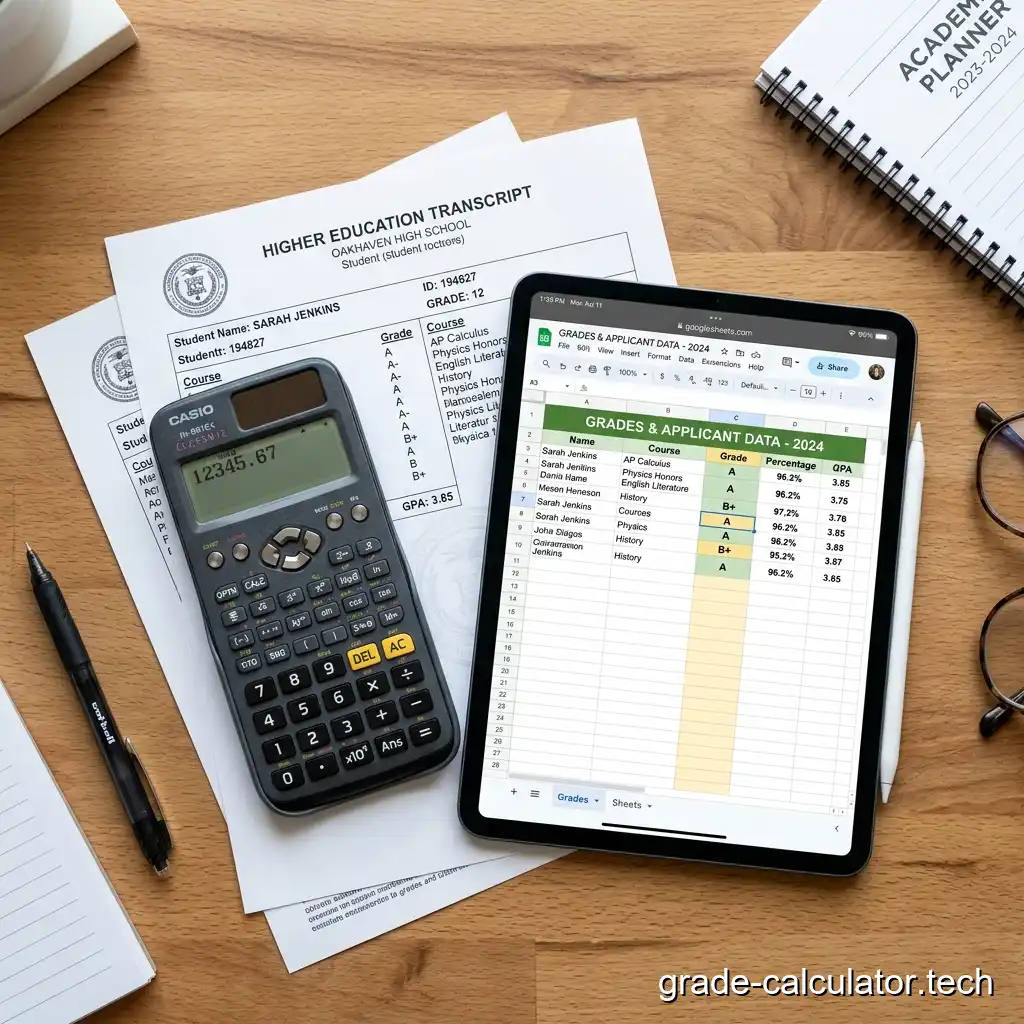
Knowing exactly how to calculate cumulative gpa in high school is a critical skill for any student looking to plan their academic future, apply for scholarships, or prepare for college admissions. Your grade point average (GPA) is one of the most significant indicators of your academic performance over time, and a cumulative GPA provides a holistic view of your entire high school career from freshman year to graduation. Whether you are aiming for an Ivy League institution, a state university, or simply want to track your progress to ensure you remain eligible for certain programs, understanding the math behind your grades empowers you to take control of your educational journey.
In this comprehensive guide, we will dive deep into everything you need to know about high school GPAs. We will break down the differences between weighted and unweighted scales, explore step-by-step calculation methods, provide clear examples, and answer the most frequently asked questions. By the end of this article, you will have a master-level understanding of how your grades are compiled, what factors influence your final number, and the strategic steps you can take to boost your GPA before sending out your college applications.
Understanding Cumulative GPA
Before we can dive into the calculations, we first need to define what exactly a cumulative GPA is. A Grade Point Average (GPA) is a standardized way of measuring academic achievement in the United States and many other educational systems. Instead of looking at individual test scores, assignments, or daily homework grades, a GPA converts your final letter grade in each class into a numerical value. These values are then averaged together to produce a single number that represents your overall academic standing.
The term "cumulative" means that this number includes all the grades you have earned throughout your entire high school career, starting from your very first day of ninth grade (and sometimes even earlier, if you took high school-level courses in middle school). Unlike a "semester GPA," which only looks at your performance during a specific term, your cumulative GPA is an ongoing, rolling average. Every time you finish a semester and new final grades are posted to your transcript, your cumulative GPA updates to reflect the new data.
Most high schools use a standard 4.0 scale, where an A is worth 4 points, a B is worth 3 points, a C is worth 2 points, a D is worth 1 point, and an F is worth 0 points. However, as we will discuss later, the introduction of advanced classes like Honors, Advanced Placement (AP), and International Baccalaureate (IB) has led to the widespread use of weighted scales that go beyond the traditional 4.0 limit.
Why Your Cumulative GPA Matters
You might be wondering why there is so much emphasis placed on this one specific number. While it's true that you are more than just a number and colleges increasingly use holistic admissions processes, your cumulative GPA remains one of the most critical pieces of your academic profile. Here are several reasons why maintaining a strong cumulative GPA is essential:
- College Admissions: College admissions officers use your cumulative GPA as a primary metric to evaluate your academic readiness. It tells them how well you handle coursework over an extended period. A consistently high GPA demonstrates discipline, work ethic, and intellectual capability. While standardized test scores (like the SAT or ACT) offer a snapshot of your test-taking ability on a single day, your GPA reflects years of sustained effort.
- Scholarships and Financial Aid: Many academic scholarships—both from institutions and private organizations—have strict GPA requirements. A higher GPA often translates directly into more financial aid opportunities, potentially saving you thousands of dollars in tuition costs.
- Class Rank: High schools often use cumulative GPAs to determine class rank, which compares your academic performance to that of your peers. Being in the top 10% or 25% of your graduating class can open doors to specific college programs, automatic admission policies (such as the Top 10% Rule in Texas), and prestigious honors.
- High School Graduation Requirements: Most high schools require students to maintain a minimum cumulative GPA (usually around a 2.0 or higher) to be eligible for graduation. Falling below this threshold could mean having to retake classes or enroll in credit recovery programs.
- Extracurricular Eligibility: To participate in school sports, clubs, and other extracurricular activities, you typically need to maintain academic eligibility. A poor cumulative GPA can result in being benched from the team or suspended from participation until your grades improve.
Weighted vs. Unweighted GPA: What's the Difference?
One of the most confusing aspects of high school academics is the difference between weighted and unweighted GPAs. To accurately track your progress, you must understand both systems and how they impact your transcript.
Unweighted GPA
An unweighted GPA is the most traditional and straightforward method of calculating your grade point average. In this system, the difficulty of the course is entirely ignored. An 'A' in a remedial math class is given the exact same point value as an 'A' in AP Calculus. The unweighted scale is capped at a 4.0. Because it treats all classes equally, the unweighted GPA is often considered a pure measure of how well you performed in the classes you chose to take, regardless of their rigor.
The standard unweighted scale looks like this:
- A = 4.0 points
- B = 3.0 points
- C = 2.0 points
- D = 1.0 points
- F = 0.0 points
Weighted GPA
A weighted GPA, on the other hand, takes course rigor into account. High schools recognize that earning a 'B' in an incredibly difficult college-level AP course requires significantly more effort and intellect than earning an 'A' in a standard, entry-level elective. To reward students for challenging themselves with rigorous coursework, schools add extra "weight" or point values to advanced classes.
In a weighted system, the scale often extends to a 5.0 or sometimes even a 6.0, depending on the school district's specific policies. A common weighted scale might look like this:
- Standard Classes: A = 4.0, B = 3.0, C = 2.0, D = 1.0, F = 0.0
- Honors Classes (usually +0.5 weight): A = 4.5, B = 3.5, C = 2.5, D = 1.5, F = 0.0
- AP/IB/Dual Enrollment Classes (usually +1.0 weight): A = 5.0, B = 4.0, C = 3.0, D = 1.0, F = 0.0 (Note that F's rarely receive extra weight because failing an advanced class does not demonstrate mastery of the subject).
Colleges will often look at both your weighted and unweighted GPAs to get a complete picture. They want to see that you challenged yourself (reflected in a high weighted GPA) while also maintaining strong foundational academic performance (reflected in the unweighted GPA).
How to Calculate Cumulative GPA in High School: Step-by-Step Guide
Now that we have established the foundational concepts, let's walk through the actual mathematical process of calculating your cumulative GPA. It might seem intimidating if you have a transcript filled with dozens of classes, but the formula is actually quite simple once you break it down.
Step 1: Assign a GPA Value to Each Grade
First, gather your high school transcript or all of your report cards from 9th grade onward. For every final semester grade you have earned, assign it a numerical value based on your school's scale. If you are calculating an unweighted GPA, use the standard 4.0 scale. If you are calculating a weighted GPA, make sure you apply the appropriate bonus points for your Honors and AP courses.
Step 2: Multiply by Credits (Calculate Quality Points)
Not all classes carry the same credit weight. A standard year-long class is typically worth 1.0 credit, while a semester-long class (like Health or Government) might only be worth 0.5 credits. To find your "Quality Points" for each class, multiply the numerical GPA value of your grade by the number of credits the class is worth.
Example: If you got an 'A' (4.0) in a class worth 0.5 credits, your Quality Points for that class would be 4.0 x 0.5 = 2.0.
Step 3: Add Up Total Quality Points and Credits
Once you have calculated the Quality Points for every single class on your transcript, add them all together to get your "Total Quality Points." Then, add up the total number of credits you have attempted.
Step 4: Divide Total Points by Total Credits
The final step is the easiest. Divide your Total Quality Points by your Total Credits Attempted. The resulting number is your cumulative GPA. Usually, this number is rounded to the second or third decimal place (e.g., 3.85 or 3.846).
Examples of Calculating Cumulative GPA
To make this process perfectly clear, let's look at two detailed examples simulating a student's transcript.
Example 1: Basic Unweighted GPA Calculation
Let's say a student has completed a semester with the following classes and standard 1.0 credits each:
- English 10: A (4.0 points x 1.0 credit = 4.0 Quality Points)
- Biology: B (3.0 points x 1.0 credit = 3.0 Quality Points)
- Algebra II: B (3.0 points x 1.0 credit = 3.0 Quality Points)
- World History: C (2.0 points x 1.0 credit = 2.0 Quality Points)
- Physical Education: A (4.0 points x 1.0 credit = 4.0 Quality Points)
Total Quality Points: 4.0 + 3.0 + 3.0 + 2.0 + 4.0 = 16.0
Total Credits: 5.0
GPA Calculation: 16.0 / 5.0 = 3.20 Unweighted GPA
Example 2: Weighted GPA with Honors/AP Classes and Half-Credits
Now let's look at a more complex example involving weighted classes and a half-credit elective.
- AP English 11 (1.0 credit): B (4.0 weighted points x 1.0 = 4.0 Quality Points)
- Honors Pre-Calculus (1.0 credit): A (4.5 weighted points x 1.0 = 4.5 Quality Points)
- Physics (1.0 credit): B (3.0 unweighted points x 1.0 = 3.0 Quality Points)
- AP US History (1.0 credit): A (5.0 weighted points x 1.0 = 5.0 Quality Points)
- Health (0.5 credit): A (4.0 unweighted points x 0.5 = 2.0 Quality Points)
- Band (1.0 credit): A (4.0 unweighted points x 1.0 = 4.0 Quality Points)
Total Quality Points: 4.0 + 4.5 + 3.0 + 5.0 + 2.0 + 4.0 = 22.5
Total Credits: 1.0 + 1.0 + 1.0 + 1.0 + 0.5 + 1.0 = 5.5
GPA Calculation: 22.5 / 5.5 = 4.09 Weighted GPA
Notice how taking rigorous AP and Honors courses allowed the student in Example 2 to achieve a GPA higher than a 4.0, even with some 'B' grades on their transcript.
Converting Letter Grades and Percentages to GPA
One of the challenges students face when transferring schools or applying to programs with different grading systems is converting percentage grades into the standard 4.0 GPA scale. While the exact conversion can vary slightly depending on your school district's specific grading policy, the College Board provides a widely accepted conversion table that is standard across most US institutions.
Here is the standard conversion chart you can use as a reference:
- A+ / A (93-100%): 4.0 GPA
- A- (90-92%): 3.7 GPA
- B+ (87-89%): 3.3 GPA
- B (83-86%): 3.0 GPA
- B- (80-82%): 2.7 GPA
- C+ (77-79%): 2.3 GPA
- C (73-76%): 2.0 GPA
- C- (70-72%): 1.7 GPA
- D+ (67-69%): 1.3 GPA
- D (65-66%): 1.0 GPA
- F (Below 65%): 0.0 GPA
It is important to note that some schools do not use plus (+) or minus (-) modifiers. In these "flat grading" systems, a 90% and a 99% are both considered an 'A' and receive a flat 4.0 points. If your school uses plus/minus grading, it is generally considered a more accurate reflection of your exact performance, but it also means that a low 'A' (A-) drops your GPA slightly from a perfect 4.0 down to a 3.7.
How Do Different High Schools Calculate GPA?
You might be surprised to learn that there is no federally mandated, universal standard for calculating high school GPAs. Because education in the United States is primarily managed at the state and local district level, school districts have the autonomy to design their own grading scales. This can lead to significant discrepancies when comparing students from different schools.
For example, some highly competitive high schools use a 100-point scale instead of a 4.0 scale. In this system, your cumulative GPA might be an 88.5 or a 94.2. Other schools might use a 12-point scale or an 11-point scale (common in some parts of Canada and select US private schools). Furthermore, some districts weight AP classes by adding 1.0 point, while others only add 0.5 points or multiply the grade by a specific coefficient.
Because of this massive variation, college admissions offices undergo a process called "recalculating GPAs." When you submit your transcript to a university, the admissions committee will often strip away your high school's specific weighting system and recalculate your unweighted GPA using their own internal standard. This ensures that a student from a school that gives out 6.0 GPAs for AP classes is judged fairly against a student from a school that caps all GPAs at 4.0.
Colleges will typically recalculate your GPA focusing strictly on "core academic subjects"—English, Math, Science, Social Studies, and Foreign Languages. They often exclude grades from electives like physical education, art, or health, as they want to measure your core academic competency.
Does Middle School Count Toward High School Cumulative GPA?
A very common question among anxious eighth graders and their parents is whether middle school grades will impact the high school cumulative GPA. Generally speaking, the answer is no. Standard middle school classes (7th and 8th grade English, Math, Science, etc.) do not appear on your high school transcript and are not factored into your college admissions GPA.
However, there is one major exception: High School Level Courses taken in Middle School. Many advanced middle school students take courses like Algebra I, Geometry, or Level I of a Foreign Language (e.g., Spanish I or French I) during their 7th or 8th-grade years. Because these are technically high school curriculum classes, many school districts will list them on the official high school transcript.
Depending on your school district's specific policy, the grades earned in these middle school advanced classes may be factored into your high school cumulative GPA. Some districts include both the credit and the grade in the GPA calculation, while others award the high school credit but exclude the grade from the GPA formula to protect young students from mistakes made before they fully matured into high schoolers. If you are unsure, you should consult your middle school guidance counselor to understand exactly how your district handles these early credits.
How to Improve Your Cumulative GPA Over Time
If you've calculated your cumulative GPA and aren't entirely thrilled with the result, don't panic. A cumulative GPA is a living, breathing number until the day you graduate. While it becomes harder to change your cumulative GPA drastically as you accumulate more credits (because each new grade represents a smaller percentage of the total average), it is always possible to show an upward trend.
Colleges love to see an "upward trajectory." If you struggled during your freshman year but slowly improved your grades into your junior and senior years, admissions officers will view that as a sign of maturity, resilience, and readiness for college-level work. Here are some strategic ways to improve your cumulative GPA:
Take Strategic Course Loads
Balance is key. It might be tempting to load up on five AP classes to boost your weighted GPA, but if you become overwhelmed and earn C's and D's, your GPA will actually suffer. Take advanced classes in the subjects you are naturally strong in, and balance them out with standard-level classes in subjects you find more difficult. Protecting your unweighted GPA is just as important as chasing weighted points.
Utilize Grade Forgiveness or Summer School
Many high schools offer "grade forgiveness" or credit recovery programs. If you failed a class or received a very low grade (like a D) early in your high school career, you might be able to retake that exact course during summer school or online. In many districts, the new, higher grade will replace the old failing grade in your GPA calculation, providing a massive boost to your overall average. Check with your academic advisor to see if this is an option at your school.
Seek Tutoring and Extra Help Early
Do not wait until the week before final exams to ask for help. The most successful students identify when they are struggling within the first few weeks of a semester. Attend your teachers' office hours, form study groups with high-performing peers, or seek out peer tutoring centers at your school. Catching a misunderstanding early can prevent a bad test grade from dragging down your final semester average.
Focus on the Syllabi and Rubrics
Treat every class like a game where the syllabus holds the rules. If a teacher weights homework as 40% of the final grade, you absolutely cannot afford to miss assignments, even if you ace the tests. Conversely, if tests are 70% of the grade, you must dedicate the majority of your time to active recall study techniques. Understanding how your final grade is calculated within the classroom is the first step to securing the 'A' that will eventually boost your cumulative GPA.
Frequently Asked Questions (FAQs)
To ensure we have covered every possible angle, let's address some of the most frequently asked questions regarding cumulative GPAs.
Q: Is a 3.5 cumulative GPA considered good?
A: Yes, a 3.5 unweighted GPA is generally considered very good. It indicates that your grades consist mostly of A's and B's. A 3.5 GPA will make you a competitive applicant for a vast majority of public state universities and many private colleges, though it might be on the lower end for highly selective Ivy League institutions.
Q: How do colleges view a 4.0 unweighted GPA vs. a 4.5 weighted GPA?
A: A 4.0 unweighted GPA means you earned an A in every single class you took. However, if your weighted GPA is also a 4.0 (meaning you took no Honors or AP classes), colleges might worry that you didn't challenge yourself. A student with a 3.8 unweighted but a 4.5 weighted GPA (meaning they got a few B's in very hard AP classes) is often viewed more favorably because they demonstrated a willingness to tackle college-level rigor.
Q: Can I raise my cumulative GPA by 0.5 points in my senior year?
A: Mathematically, this is extremely difficult, if not impossible, depending on how many credits you already have. Because your cumulative GPA is an average of three years of work (say, 18 to 21 credits), a few good grades in your senior year won't shift the massive average by half a point. However, earning straight A's in your senior year will show an upward trend, which is highly beneficial for college admissions.
Q: Does my cumulative GPA reset every year?
A: No. A cumulative GPA never resets; it continually averages all the credits you have earned since you started high school. Your semester or yearly GPA resets, allowing you to earn a 4.0 for a specific academic year, but your cumulative GPA will always include your past performance.
Q: Do colleges care about my freshman year grades?
A: Yes and no. They do look at them, and they are factored into your overall cumulative GPA. However, many colleges are forgiving of a rocky freshman year, provided they see significant improvement in sophomore and junior years. Some university systems (like the University of California system) actually ignore freshman year entirely when calculating your GPA for admissions purposes.
Calculating your cumulative GPA doesn't have to be a mystery. By understanding the difference between weighted and unweighted scales, tracking your quality points, and carefully selecting your courses, you can take proactive control of your academic narrative. Use the math to your advantage, strive for a steady upward trend, and remember that while your GPA is incredibly important, it is ultimately just one part of your broader educational journey.